Your Cart is Empty
Start shopping

Sodium hyaluronate, the Euflexxa generic name, is a naturally occurring substance in the human body that helps lubricate joints and absorb shock during movement. In individuals with knee osteoarthritis, levels of this compound in the synovial fluid decline, contributing to increased joint friction, inflammation, and pain. This deficiency has led to the development of viscosupplementation, a therapy that injects hyaluronic acid directly into the joint to help restore comfort and mobility.
Among the products used in this approach is Euflexxa, a non-avian, high-molecular-weight form of sodium hyaluronate. Unlike some alternatives sourced from rooster combs, Euflexxa is produced through bacterial fermentation, reducing exposure to avian-derived proteins.
In this article, we’ll explore Euflexxa’s generic name, examine how sodium hyaluronate works in osteoarthritis treatment, and highlight its role in modern joint care. Licensed practitioners who plan to buy Euflexxa wholesale should verify product authenticity and source it only from a reputable medical supplier.
Key Takeaways
- Sodium hyaluronate, the generic name for Euflexxa, is a naturally occurring substance used to restore joint lubrication in osteoarthritis (OA) patients.
- Euflexxa is bioengineered using bacterial fermentation, making it free of animal proteins and safe for those with avian or egg allergies.
- The product has a molecular weight of 2.4–3.6 million Daltons, which contributes to its strong viscoelastic properties and ability to cushion the joint.
- Unlike some HA injectables, Euflexxa is non-cross-linked, promoting a more natural joint feel and lowering the likelihood of adverse reactions.
- Its mechanism of action is mechanical, not biochemical, meaning it physically lubricates and cushions joints without interfering with the immune system.
- Emerging research suggests sodium hyaluronate may also stabilize the joint environment and help reduce inflammation and oxidative stress over time.
- The FDA classifies Euflexxa as a Class II medical device, emphasizing its physical mode of action rather than systemic drug-like effects.
- Standard dosing for Euflexxa is 2 mL once a week for three weeks; Orthovisc is also 2 mL weekly, typically over 3–4 weeks—not every two weeks.
- Alternative HA products like Hyalgan are avian-derived and may not be suitable for individuals with animal protein sensitivities.
- Providers must consider formulation origin, injection protocol, molecular weight, and patient-specific allergies when selecting a viscosupplement.
- Euflexxa is ideal for patients seeking a non-steroidal, allergy-safe, and well-tolerated option to manage knee OA symptoms.
About: Doctor Medica is your trusted supplier of top-quality dermal fillers, viscosupplements, and a range of medical and aesthetic products for your practice. We offer authentic products from leading brands at the lowest prices. Contact Doctor Medica today!
Recommended products
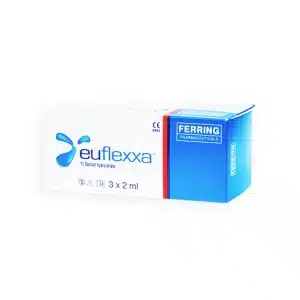

Euflexxa Generic Name: Chemical Structure and Origin
Understanding the Euflexxa generic name (sodium hyaluronate) requires a look into its structural composition and manufacturing source. This bioengineered compound is formulated to replicate the properties of natural synovial fluid, offering both mechanical support and shock absorption in osteoarthritic knees.
Sodium hyaluronate is the sodium salt form of hyaluronic acid.[3] It is composed of repeating disaccharide units that give it the viscoelastic consistency needed for joint lubrication. Looking closely at Euflexxa, its molecular weight ranges between 2.4 to 3.6 million Daltons, offering a consistent, smooth texture that facilitates better joint mobility and longer-lasting joint coating.
Unlike some chemically cross-linked HA injectables, Euflexxa remains non-cross-linked, contributing to its natural feel and lower risk of post-injection complications. Because it is produced via bacterial fermentation, Euflexxa avoids animal proteins and potential allergens found in avian-derived products like those made from rooster combs.
Moreover, the product undergoes rigorous filtration and sterilization, reducing the presence of endotoxins and ensuring high purity, which is an important safeguard against inflammation and hypersensitivity reactions.
In essence, sodium hyaluronate serves as both a biomechanical lubricant and cushioning agent with a safety profile suitable for a wide range of patients, especially those with allergies to egg or bird proteins.
Pharmacodynamics and Mechanism

As a viscosupplement, sodium hyaluronate works locally within the knee joint, not systemically.[2] Its main action is mechanical rather than biochemical, setting it apart from anti-inflammatory drugs.
- It restores the viscoelasticity of the synovial fluid, enhancing lubrication and reducing friction between cartilage surfaces.
- Patients often report less stiffness and improved mobility in daily activities like walking or climbing stairs.
- Rather than suppressing inflammation, it acts as a shock absorber and joint buffer, redistributing mechanical loads during movement.
- Emerging research suggests sodium hyaluronate may also help reduce oxidative stress and inflammatory mediators in the joint microenvironment.
- It may promote the body’s own production of hyaluronic acid through interaction with cell-surface receptors like CD44, although this is still under investigation and not an established clinical mechanism.
These features make sodium hyaluronate a non-steroidal and well-tolerated option for long-term osteoarthritis care. In the 26-week FLEXX trial, three weekly Euflexxa injections produced a significantly greater reduction in knee pain during a 50-foot walk test than saline.[1]
Regulatory and Classification Context

The U.S. FDA classifies Euflexxa as a Class II medical device, reflecting its primary role in mechanical joint function restoration rather than chemical modification of disease pathways.
- Unlike corticosteroids or DMARDs, it does not alter immune signaling, but still must meet strict sterility, safety, and performance standards.
- Medical professionals are still required to conduct proper patient screening, aseptic injection technique, and post-treatment evaluation.
- Its device classification offers reassurance for patients who are wary of systemic drug effects or looking for non-pharmaceutical OA treatments.
Despite this classification difference, the clinical rigor in administering Euflexxa remains equivalent to that of conventional drug therapies.
Comparative Landscape Within HA Products
When evaluating Euflexxa vs Orthovisc and other HA-based viscosupplements, several factors come into play: source, molecular weight, allergy potential, and injection protocol.
| Feature | Euflexxa | Orthovisc | Hyalgan |
| Source | Bacterial fermentation (non-avian) | Formerly avian; now bacterial fermentation | Rooster combs (avian-derived) |
| Molecular Weight | ~2.4–3.6 million Daltons | ~1.0–2.9 million Daltons | ~0.5–0.73 million Daltons |
| Injection Protocol | 1 injection/week for 3 weeks | 1 injection/week for 3–4 weeks | 1 injection/week for 5 weeks |
| Immunogenicity Risk | Low – no animal proteins | Low – now non-avian | Higher – contains avian proteins |
| Cross-Linking | None | ||
| FDA Approval | Yes (for knee OA) | ||
| Ideal for Allergic Patients | Yes – suitable for egg/bird allergies | Not ideal – risk for bird/egg allergies | |
When comparing the pros and cons of Euflexxa, its consistent high molecular weight, simple weekly schedule, and non-avian origin make it a strong option for those needing predictable results without immune-related risks.
In contrast, Orthovisc now shares a non-avian origin, but offers a slightly broader molecular weight profile, which some clinicians believe may prolong the therapeutic effect—though individual response varies.
Conclusion
The Euflexxa generic name, sodium hyaluronate, represents more than just a compound; it encapsulates a biomechanically driven therapy aimed at enhancing quality of life for osteoarthritis sufferers. Its non-animal origin, viscoelastic performance, and mechanical cushioning make it a top choice for patients seeking non-steroidal joint support.
When comparing treatments like Euflexxa vs Orthovisc, factors like molecular weight, production history, and injection frequency provide helpful distinctions. Patients should consult their healthcare provider to choose the product that best matches their clinical profile, treatment goals, and allergy sensitivities.
FAQs
1. Is sodium hyaluronate the same as hyaluronic acid?
Mostly yes—sodium hyaluronate is the salt form of hyaluronic acid. It’s more stable and suitable for injection, performing the same functions in joints.
2. Why does Euflexxa not contain animal proteins?
Euflexxa is made via bacterial fermentation, ensuring it’s free from avian or egg-derived proteins. This reduces allergy risk compared to some other HA products.
3. How does Euflexxa differ from Orthovisc?
Both products contain sodium hyaluronate and are administered as a series of weekly knee injections. Euflexxa is normally given once weekly for three weeks, while Orthovisc may involve three or four weekly injections.
4. Do I need a prescription or a specialist to get Euflexxa?
Yes—Euflexxa is available by prescription and is injected into the knee joint by a healthcare professional.[4] Proper injection technique and follow-up care are essential for safety and effectiveness.
Citations
[1] Altman, Roy D et al. “A double-blind, randomized, saline-controlled study of the efficacy and safety of EUFLEXXA for treatment of painful osteoarthritis of the knee, with an open-label safety extension (the FLEXX trial).” Seminars in arthritis and rheumatism vol. 39,1 (2009): 1-9. doi:10.1016/j.semarthrit.2009.04.001
[2] “Viscosupplementation Treatment for Arthritis.” Johns Hopkins Medicine, www.hopkinsmedicine.org/health/conditions-and-diseases/arthritis/viscosupplementation-treatment-for-arthritis.
[3] Nunez, Kirsten. “What Is Sodium Hyaluronate and How Is It Used in Skin Care?” Healthline, 28 Jan. 2024, www.healthline.com/health/beauty-skin-care/sodium-hyaluronate.
[4] “Euflexxa Injection: Uses, Side Effects, Dosage & More.” GoodRx, reviewed by Kristianne Hannemann and Allison Gourley, 6 Nov. 2024, www.goodrx.com/euflexxa/what-is.
The content on this page has been written and fact-checked in accordance with our Editorial Policy. Clinical claims are sourced from peer-reviewed literature, regulatory documentation, and manufacturer specifications. Where citations are provided, it is always in accordance to our editorial standards.