What Are Exosomes? A Clinical Introduction to Extracellular Vesicle Therapy
Exosomes are nanoscale extracellular vesicles that cells release as part of intercellular communication. Typically 30–150 nm in size, they can transport proteins, lipids, nucleic acids, and signaling molecules between cells. In aesthetic medicine, practitioners are investigating extracellular vesicle preparations for skin rejuvenation, post-procedure recovery, and hair restoration. Human clinical evidence is growing, but formulations, sources, manufacturing standards, and regulatory status remain highly variable.[1]
Exosomes originate as intraluminal vesicles (ILVs) within multivesicular bodies. When a multivesicular body fuses with the plasma membrane, its ILVs are released into the extracellular space as exosomes. Their cargo may then interact with recipient cells and influence signaling processes involved in tissue homeostasis and repair.
Many experimental products use cell-derived exosomes, with vesicles from mesenchymal stem cells among the most studied in regenerative medicine. However, mesenchymal stem origin alone does not establish quality or clinical efficacy. Modern extracellular vesicle guidelines emphasize characterizing the actual preparation rather than relying solely on source or marketing terminology.[3]
The Science of Exosome Therapy — How Extracellular Vesicles Work in Skin
Exosome therapy relies on biological signaling rather than physical filling. Following exosome uptake, vesicular cargo may influence fibroblasts, keratinocytes, immune cells, and other recipient cells through proteins, lipids, microRNA, and related signaling molecules.
Preclinical and clinical research links extracellular vesicle activity to pathways involved in collagen and extracellular matrix production, inflammation, wound healing, and the regulation of oxidative stress and reactive oxygen species. A recent scoping review of facial esthetics and skin aging reported encouraging associations with improvements in texture, hydration, elasticity, pigmentation, and wrinkle appearance, while noting substantial differences between products and study protocols.[4]
Product characterization matters more than a high particle count. Differential ultracentrifugation may be used in vesicle isolation; flow cytometry, resistive pulse measurements, and mass spectrometry can contribute to characterization. Complementary methods are needed to assess identity, concentration, and purity.[3]
Types of Exosomes Used in Aesthetic Medicine
Products marketed within aesthetic exosome therapy differ substantially in biological source and delivery format.
Stem Cell-Derived Extracellular Vesicles
Preparations associated with mesenchymal stem cells are among the most researched. Their proposed regenerative effects relate to signaling cargo rather than transplanting living stem cells. Researchers are investigating these products for skin repair, inflammation modulation, hair restoration, and other regenerative applications.
Plant-Derived Vesicles
Researchers are investigating plant-derived extracellular vesicle-like particles for antioxidant and signaling properties. In aesthetics, they appear primarily in topical exosomes, cosmetic formulations, and exosome serums, rather than as substitutes for well-characterized human extracellular-vesicle preparations.
Platelet-Derived Vesicles
Platelets also release extracellular vesicles containing biologically active signaling molecules. Platelet-derived products have consequently entered the topical regenerative skincare market, including products commonly searched as plated exosomes.
Topical and Procedure-Assisted Delivery
An exosome serum may be used on intact skin according to its labeling. Microneedling with exosomes is also discussed in the literature, but a topical label does not establish suitability for application to disrupted skin or delivery through treatment-induced microchannels.
Some products are marketed internationally for exosome injection. Such use warrants greater regulatory caution: there is no universally accepted injectable dose or standardized treatment protocol, and no exosome product is FDA-approved in the United States.[5]
Clinics planning to buy exosome serums should therefore distinguish topical cosmetic products from preparations intended for injection, and verify the intended routes of administration stated in the current product documentation.
Applications Under Investigation — Skin, Hair, and Wound Healing
Skin Rejuvenation
Research into facial applications of exosome preparations has examined skin texture, hydration, pigmentation, and recovery. An exosome facial may involve a topical formulation or a procedure-assisted approach. However, the evidence for exosome therapy for skin rejuvenation remains preliminary and varies between preparations.[2]
Research on skin physiology and rejuvenation has also increased interest in exosome-based skincare. However, cosmetic marketing terminology does not establish product-specific efficacy.
Microneedling With Exosomes
Small studies of microneedling with exosomes suggest possible improvements in hydration, pigmentation, or texture compared with needling alone, but sample sizes and protocols vary.[1] Product suitability for application to treated skin must be established separately.
The term “stem cell exosome microneedling” describes an investigational combination of microneedling and stem-cell-associated vesicle preparations. Before considering this approach, clinicians should review the product’s intended use, sterility documentation, contraindications, and instructions for application to treated skin.
Hair and Scalp Applications
Research on exosomes for hair growth examines follicular signaling and inflammation. A 2026 meta-analysis reviewed 39 human studies, including 13 focused on hair, and reported improvements in density and thickness despite substantial variation in study methods.[2]
Exosome hair therapy remains investigational. Clinicians should not equate it with established drug treatment or assume the findings apply to all products.
Wound Healing and Recovery
Extracellular vesicles are being investigated for wound-healing pathways, including angiogenesis and inflammatory regulation. These findings do not establish that any particular aesthetic preparation accelerates clinical recovery.
Exosomes vs Biostimulators and Skin Boosters — Understanding the Distinctions
Exosomes, biostimulators, and skin boosters may all appear in regenerative treatment plans, but they should not be treated as interchangeable products.
Exosomes function primarily as biological signaling vehicles. They may deliver proteins, RNA, lipids, and other signaling cargo involved in cellular communication. They do not provide the same direct mechanical volume effect as a traditional filler.
Practitioners planning to buy biostimulators can compare PLLA-, CaHA-, and PCL-based products, which stimulate tissue responses associated with collagen formation. Some also provide structural correction or immediate volume, depending on the formulation.
By contrast, clinics that buy skin boosters are generally selecting hydration and superficial skin quality improvement, commonly through hyaluronic acid-based formulations.
Exosome Treatment vs Radiofrequency Microneedling
Exosome preparations and radiofrequency microneedling are not interchangeable treatments. RF microneedling creates controlled thermal and mechanical stimulation, whereas exosome preparations are investigated for their biological signaling properties. Some protocols combine these approaches, but evidence for the optimal combination is still emerging.
EXOJUV and Other Exosome Brands for Clinical Comparison
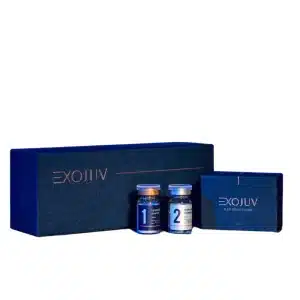
EXOJUV is supplied as a lyophilized powder with a separate activator. The current product listing specifies a 50 mg powder vial and a 5 mL companion solution. Clinicians should verify the manufacturer’s documentation for vesicle source, particle concentration, preparation instructions, and intended application before selecting it for a protocol. Product suitability must also be assessed against applicable local regulations.
Other names practitioners encounter in this category include:
- ANTEAGE exosomesare associated with the brand’s professional topical Exosome Solution, which the manufacturer describes as containing vesicles from two human stem-cell sources. Its instructions specify cosmetic topical use rather than injection.
- BENEV exosomesfeature in professional post-treatment skincare, including the Exosome Regenerative Complex range. BENEV specifies topical cosmetic use and expressly excludes injection.
- HANHEAL exosomesare encountered in Korean professional aesthetics. Clinicians should assess the specific presentation and manufacturer instructions rather than assume the products share one route or formulation.
- MUSELY exosomes appear in consumer-oriented topical skincare, including a neck cream marketed with exosome terminology; that labeling alone does not establish vesicle composition or clinical efficacy.
- The MEDICUBE Exosome Shotis a consumer skincare product incorporating exosome-branded ingredients and spicules. It should not be equated with a characterized clinical extracellular-vesicle preparation.
- PLATED exosomes refer to the brand’s platelet-derived extracellular-vesicle skincare technology; the products are marketed as topical serums.
For this category, brand name alone should never substitute for documentation on vesicle source, characterization, sterility, storage, and intended use.
Dosage, Protocols, and Time to See Results
No standardized dosing schedule applies across exosome products. Studies vary in preparation, concentration, application, and treatment intervals, so clinicians should not derive a universal protocol from a review.[1]
Where exosomes for microneedling are studied, application methods depend on the investigational protocol. Marketing of injectable formats internationally does not establish their authorization or suitability for clinical injection.
Studies generally evaluate skin or scalp changes over weeks or months. Evidence does not support a universal onset of results or a fixed 6–12-month duration for every product.
When comparing the best exosomes for skin, practitioners should prioritize evidence for the exact formulation, its permitted route, characterization, and handling requirements.
Clinical Benefits of Exosome Therapy
Exosome therapy is being studied for effects on skin hydration, elasticity, texture, pigmentation, and hair outcomes. A 2026 meta-analysis reported improvements across heterogeneous human studies, but its findings cannot establish efficacy for any particular commercial product.[2]
Research also examines extracellular-vesicle signaling in wound healing and hair-growth applications. However, combining these preparations with aesthetic procedures requires product-specific evidence and appropriate instructions for use.
Claims about the best exosomes for skin should distinguish preliminary research from product-specific clinical outcomes. Standardized protocols and long-term safety data remain limited.
Legal Status and FDA Approval
There are currently no FDA-approved exosome products.[5] FDA states that exosome products intended to treat diseases or conditions are generally regulated as drugs and biological products and require premarket review and approval.
FDA continues to warn patients and consumers to avoid unapproved products from human cells or tissues marketed online, including products marketed as containing exosomes.[5] The agency’s safety notification remains the central reference point for US practitioners evaluating this category.
Topical cosmetic products require separate analysis based on composition, claims, and intended use. Describing a product as a “serum” does not automatically determine its regulatory classification. CE marking and authorization also vary by formulation, country, indication, and route of administration.
Practitioners who purchase exosomes online or through professional supply channels should therefore verify the current status of the exact product in their jurisdiction. Exosomes are also not biostimulators in the conventional PLLA, CaHA, or PCL sense. They represent a distinct category of extracellular vesicles with a different evidence base and regulatory landscape.
Storage and Shipping Requirements
Exosome storage cannot be standardized across the entire category. Some preparations require refrigeration, others may be supplied frozen, and lyophilized products may have different temperature requirements before and after reconstitution.
Clinics should therefore follow the product’s IFU rather than assume every preparation belongs at 2°C–8°C or that freezing is always harmful. Temperature excursions, reconstitution instructions, protection from light, and time-to-use after opening can differ materially between products.
Before clinics order exosomes online, they should confirm the product’s storage and shipping requirements. On arrival, staff should inspect packaging, expiry dates, LOT identifiers, and any applicable temperature records. Practitioners should also request shipment documentation when needed to assess whether product-specific transport conditions were maintained.
What to Consider Before You Buy Exosomes Wholesale
Exosome product prices may vary by origin, manufacturing method, formulation, packaging, and order quantity. Higher particle counts alone do not establish product quality or clinical value.
When clinics order exosomes wholesale, the unit price should be weighed against traceability, stability, intended route, and reliable product documentation.
Current EXOJUV pricing is listed on Doctor Medica. Practices planning to buy exosome serums in volume can request details of available quantity discounts. Those seeking to buy exosome therapy products for ongoing use should confirm the formulation and applicable purchasing terms before ordering.
Side Effects and Safety
Published topical and procedure-assisted studies generally report mild, temporary reactions such as redness, irritation, swelling, or procedure-related discomfort. Safety evidence remains smaller and less standardized than for established aesthetic injectables, and reviews continue to call for better long-term trials and consistent manufacturing standards.[1]
Injectable use deserves substantially greater caution. FDA has documented serious adverse events associated with unapproved products marketed as containing exosomes and continues to warn against unapproved regenerative medicine products.[5]
Patient screening should account for the exact formulation and intended procedure. Active infection at the treatment area and known hypersensitivity to product components are common reasons to defer treatment, consistent with the product IFU and clinical judgment. Pregnancy-related restrictions should be based on the manufacturer’s current IFU and local clinical guidance rather than assumed to apply across all products.
Where to Buy Exosomes Online — Doctor Medica
Doctor Medica’s professional catalog is intended for verified licensed practitioners. Available formats, prices, and product details can be reviewed in the category grid.
Before clinics buy exosome therapy products, they should check the manufacturer’s intended use and their local regulatory requirements. Practices that order exosomes for topical or procedure-adjacent care should verify suitability for the planned application.
Practices that purchase exosomes online can contact Doctor Medica about documentation, order quantities, and shipping terms. If planning to buy exosomes wholesale, compare options against actual clinic demand rather than assumed treatment outcomes.
Browse the catalog or contact the team for current EXOJUV pricing and availability.
Frequently Asked Questions
What should clinicians look for in extracellular-vesicle characterization studies?
Characterization should consider particle identity, size distribution, concentration, purity, and the limitations of the methods used. Flow cytometry, resistive pulse sensing, and mass spectrometry provide different types of information. No single measurement proves exosomal origin or establishes clinical efficacy.
Why might laboratory findings about exosomes differ from results in human studies?
Laboratory experiments can investigate specific cellular responses under controlled conditions, but they do not reproduce the complexity of human skin, scalp tissue, or clinical procedures. Findings involving cultured cells or animal models must therefore be evaluated separately from demonstrated outcomes in people.
Why are control groups important in exosome microneedling studies?
Microneedling itself can affect skin appearance and tissue responses. An appropriate control group helps researchers assess whether adding an exosome-containing preparation produces measurable benefits beyond the procedure alone. Study design and the selected outcome measures remain important when interpreting the results.
Can findings from mesenchymal stem-cell secretome research be applied to isolated exosomes?
Not automatically. Mesenchymal stem-cell secretome can contain extracellular vesicles alongside soluble proteins and other biological components. Research involving the complete secretome does not necessarily establish the effects of isolated exosomes or a different commercial preparation.
What makes an improvement in an exosome clinical trial meaningful?
Researchers should consider the size of the observed change, the reliability of the measurement method, and its relevance to the patient’s concern. A statistically significant difference does not always represent a clinically meaningful improvement.
Why does follow-up duration matter in aesthetic exosome research?
Short studies may identify early changes in skin texture, hydration, or other outcomes without establishing how long they persist. Longer follow-up is necessary to evaluate durability, delayed adverse effects, and whether reported improvements remain consistent over time.
Does an investigational exosome study mean the product is FDA approved?
No. Permission to conduct a clinical investigation under an Investigational New Drug (IND) application is not equivalent to FDA marketing approval. Practitioners must distinguish investigational use from authorized commercial indications. The FDA states that there are currently no FDA-approved exosome products.
What makes an exosome clinical study relevant to a particular product?
Clinicians should determine whether the study examined the same biological source, preparation method, formulation, and application route as the product being considered. Sample size, control groups, outcome measures, and follow-up duration also affect how confidently findings can be interpreted. Results from one preparation should not automatically be generalized to another.
For licensed medical professionals only. This content is for informational purposes only and does not constitute medical advice.
Citations and Resources
[1] Shah, Milaan et al. “Exosomes for Aesthetic Dermatology: A Comprehensive Literature Review and Update.” Journal of cosmetic dermatology vol. 24,1 (2025): e16766. doi:10.1111/jocd.16766
[2] Stack, Emily R et al. “Clinical Advances in Exosome-Based Therapies for Aesthetic Medicine: A Systematic Review and Meta-analysis of Human Clinical Trials.” Aesthetic surgery journal vol. 46,12 Suppl 2 (2026): S13-S25. doi:10.1093/asj/sjaf178
[3] Welsh, Joshua A et al. “Minimal information for studies of extracellular vesicles (MISEV2023): From basic to advanced approaches.” Journal of extracellular vesicles vol. 13,2 (2024): e12404. doi:10.1002/jev2.12404
[4] Miron, Richard J et al. “Understanding exosomes in facial esthetics and skin aging.” Periodontology 2000, 10.1111/prd.70053. 14 May. 2026, doi:10.1111/prd.70053
[5] U.S. Food and Drug Administration. “Public Safety Notification on Exosome Products.” U.S. Food and Drug Administration, 6 Dec. 2019, www.fda.gov/vaccines-blood-biologics/safety-availability-biologics/public-safety-notification-exosome-products.
Written by Doctor Medica’s Editorial team
The content on this page has been written and fact-checked in accordance with our Editorial Policy. Clinical claims are sourced from peer-reviewed literature, regulatory documentation, and manufacturer specifications. Where citations are provided, it is always in accordance to our editorial standards.
Doctor Medica sources products exclusively through authorized distributors and established procurement channels. Products are verified as genuine, and supplied in the original packaging with their seal intact. Learn more about how we guarantee product authenticity, sourcing compliance, and traceable delivery to our clients.