Your Cart is Empty
Start shopping
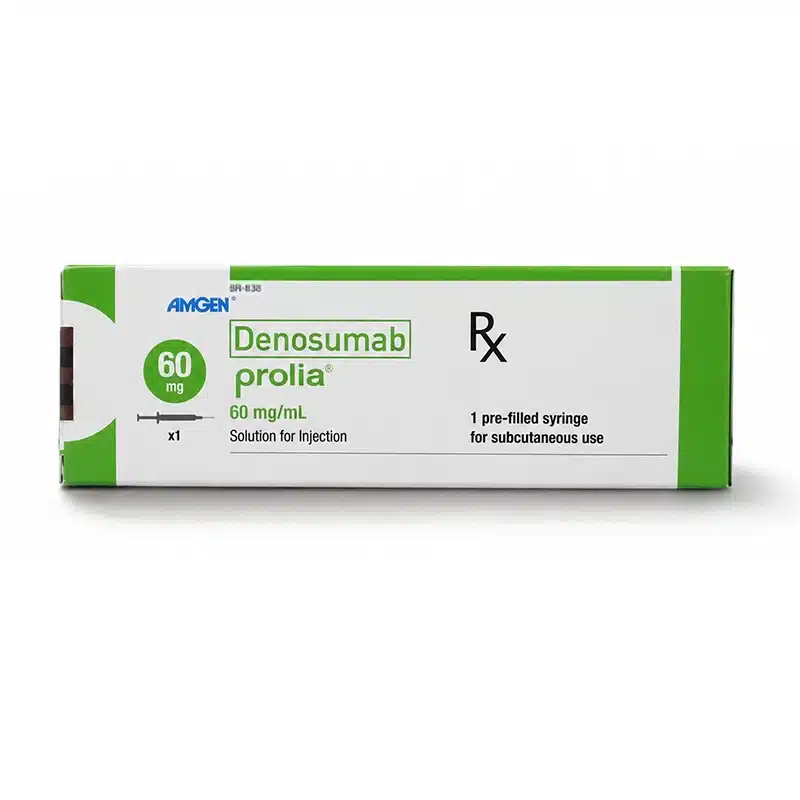
PROLIA® (International English)
Tier
| Packs | Discount (%) | For Each |
|---|---|---|
| 1 - 5 | — | $599.00 |
| 6 - 10 | 1.67 % | $589.00 |
| 11 - 20 | 2.5 % | $584.00 |
| 21+ | 3.34 % | $579.00 |
Shop with Confidence: 100% Authentic Products
All products are sourced from trusted suppliers and come with original manufacturer LOT numbers for identification and traceability.
Product description
What is Prolia®? (About This Product)
Prolia® is a fully human IgG2 monoclonal antibody — not a bisphosphonate, not a small molecule. Its active ingredient, denosumab, is produced using mammalian cell technology and acts by targeting a single protein in the bone remodeling pathway rather than depositing into the bone matrix. This is a clinically important distinction: bisphosphonates accumulate in bone and retain antiresorptive activity long after dosing stops, while denosumab circulates as a protein and clears when treatment ends. Those seeking to buy Prolia® online may contact Doctor Medica customer service for guidance on ordering pathways available to licensed professionals.
Product Specifications
| Specification | Details |
| Active Ingredient | Denosumab |
| Strength | 60mg/mL |
| Dosage Form | Single-dose prefilled syringe; subcutaneous injection |
| Manufacturer | Amgen Inc. |
| FDA Approval Date | June 2010 |
| Drug Class | RANK ligand (RANKL) inhibitor — monoclonal antibody |
| Storage Requirements | 2°C to 8°C; protect from light; do not freeze; once removed from refrigeration, use within 14 days at room temperature not exceeding 25°C |
Jubbonti vs Prolia®
Jubbonti (denosumab-bbdz) is an FDA-approved interchangeable biosimilar to U.S.-licensed Prolia®, approved in March 2024 and marketed by Sandoz. The interchangeable designation permits pharmacy-level substitution without prescriber authorization, subject to applicable state law. This distinction carries real implications for formulary and procurement.
Notably, Jubbonti’s approval is accompanied by a Risk Evaluation and Mitigation Strategy (REMS) program designed to reinforce monitoring and safety protocols regarding severe hypocalcemia in patients with advanced renal impairment.
Evenity vs Prolia®
Evenity® (romosozumab) is a sclerostin inhibitor that simultaneously stimulates bone formation and reduces resorption — a dual action distinct from Prolia®’s purely antiresorptive mechanism. Approved for up to 12 months, Evenity® is used to rapidly improve BMD in severe osteoporosis, after which patients commonly transition to a long-term antiresorptive such as Prolia®.
For more info on buy Prolia®ing Prolia®, you can contact our support staff for guidance.
How Does Prolia® Work? – Mechanism of Action Explained
RANKL — receptor activator of nuclear factor kappa-B ligand — is the molecular trigger for osteoclast maturation and survival. In osteoporosis and conditions involving hormonal suppression or corticosteroid exposure, excess RANKL activity accelerates bone resorption and skeletal fragility.
Denosumab binds RANKL with high specificity, blocking it before it reaches the RANK receptor on osteoclast precursors. It then suppresses osteoclast formation and reduces bone turnover. The result is improved bone mineral density at the spine and hip and significant reductions in vertebral, non-vertebral, and hip fracture rates in clinical trial populations.¹
Because denosumab does not incorporate into bone, its effect is fully reversible. Stopping treatment without a transition plan allows RANKL to reactivate rapidly, osteoclast activity to rebound above baseline, and BMD to fall sharply. Multiple vertebral fractures following abrupt discontinuation have been reported, making a pre-planned transition to another antiresorptive agent essential before ending therapy.
What Is Prolia® Used For? – Indications & Clinical Use
Prolia® is a prescription medicine with approved uses across four distinct patient populations, each with specific fracture-risk criteria.
- Postmenopausal osteoporosis: Indicated for postmenopausal women with osteoporosis at high risk for fracture, defined as patients with a history of osteoporotic fracture, multiple risk factors, or failure or intolerance of other osteoporosis therapy. Prolia® demonstrated significant reductions in vertebral, hip, and non-vertebral fractures in pivotal trials, establishing it as a core medicine for treating osteoporosis in this group.
- Men with osteoporosis: Prolia® is approved to increase bone mass in men with osteoporosis at high risk for fracture. Osteoporosis in men remains underdiagnosed and undertreated; Prolia® offers an established option for this population alongside standard clinical monitoring.
- Hormone ablation-related bone loss: Androgen deprivation therapy for nonmetastatic prostate cancer and adjuvant aromatase inhibitor therapy for breast cancer both suppress sex hormone levels and accelerate bone loss. Prolia® is specifically approved to increase bone mass in men at high risk for fracture receiving ADT for nonmetastatic prostate cancer, and in postmenopausal women at high risk for fracture receiving adjuvant aromatase inhibitor therapy for breast cancer. Addressing skeletal risk is an important part of managing these cancer treatments for prostate and breast cancer populations.
- Glucocorticoid-induced osteoporosis: Prolia® is approved for men and women at high risk for fracture who are initiating or continuing systemic glucocorticoids at a daily dose equivalent to prednisone 7.5mg or greater, with expected continuation for at least 6 months. Both fracture risk status and anticipated steroid duration should be confirmed before initiating therapy in this population.
Licensed practitioners reviewing treatment options for bone loss across these indications may check for wholesale purchasing options through compliant supply channels.
How is Prolia® Administered?
Each Prolia® dose is 60mg delivered in a 1mL subcutaneous injection, given once every six months. The injection must be performed by a healthcare professional — it is not indicated for self-administration. Before injecting, allow the syringe to warm naturally to room temperature; do not use external heat sources. Once removed from refrigeration, the product must be used within 14 days at a temperature not exceeding 25°C.
Accepted injection sites are:
- Upper arm
- Upper thigh
- Abdomen
Supplementation and Pre-Treatment Requirements
- All patients must receive calcium 1,000mg daily and vitamin D 400 IU daily throughout the course of treatment
- Pre-existing hypocalcemia must be fully corrected before the first dose is given
- In patients with advanced chronic kidney disease, evaluate for CKD-mineral and bone disorder — including intact parathyroid hormone, serum calcium, 25(OH) vitamin D, and 1,25(OH)₂ vitamin D — prior to treatment initiation, given the boxed warning for severe hypocalcemia in this population
If a scheduled injection is missed, administer it as soon as possible and reset the dosing interval to six months from that date.
Storage
Keep refrigerated at 2°C to 8°C in the original carton, away from light. Do not freeze or shake. Once removed from refrigeration, use within 14 days. Inspect the solution for particulates or discoloration before each use. Practices buy Prolia®ing online should confirm their supplier maintains validated cold-chain and temperature-controlled shipping protocols.
What Are Prolia®’s Side Effects & Safety Considerations?
Safety monitoring is important throughout active treatment and extends into the post-discontinuation period. Adverse reaction frequency and profile vary by indication; practitioners should consult the full prescribing information for population-specific data.
Common adverse reactions reported in postmenopausal osteoporosis trials:
- Back pain
- Pain in extremity
- Musculoskeletal pain
- Hypercholesterolemia
- Cystitis
Serious Risks Requiring Clinical Monitoring
- Hypocalcemia: Subject to a current boxed warning, with advanced chronic kidney disease patients at the highest risk. Severe hypocalcemia most commonly emerges between 2 and 10 weeks after injection, making monitoring during this window essential
- Osteonecrosis of the jaw: A routine oral exam is recommended before initiation for all patients; those with ONJ risk factors should undergo a full dental evaluation with preventive dentistry beforehand
- Atypical femoral fractures: New thigh or groin pain during treatment should prompt imaging
- Serious infections: Including skin and soft-tissue infections such as cellulitis
- Severe musculoskeletal pain: May arise at any point during therapy
- Hair loss: Alopecia appears as a common adverse reaction in the EU Summary of Product Characteristics but is absent from the most common adverse reactions in the U.S. prescribing information summary; practitioners should refer to the labeling for their jurisdiction.
- Malignancy: New malignancies were reported in clinical trials, but a causal relationship to denosumab exposure has not been established.
Discontinuing Prolia® without a transition plan can trigger rapid bone turnover rebound, substantial BMD loss, and multiple vertebral fractures. Sequential antiresorptive therapy is the standard of care before treatment is discontinued. For complete safety and interaction data, consult the full prescribing information issued by Amgen.
These safety considerations are especially relevant for specialists managing long-term osteoporosis treatment sequences or reviewing where to buy Prolia® osteoporosis treatments for clinical practice.
What Is The Legal Status of Prolia®?
Prolia® received FDA approval in June 2010 and European Union authorization in May 2010. It is a prescription-only biologic medicine; applicable dispensing and procurement requirements depend on local law and practice setting. Regulatory status is subject to change; practitioners should verify current local requirements before sourcing or prescribing.
Licensed professionals evaluating access pathways may contact Doctor Medica customer service for guidance on options available to buy Prolia® wholesale through compliant channels.
FAQ
Prolia® is a prescription biologic containing denosumab, a fully human IgG2 monoclonal antibody and RANKL inhibitor developed by Amgen and FDA-approved in June 2010 for osteoporosis and hormone ablation-related bone loss.
No. Prolia® inhibits RANKL extracellularly, and its effect fully reverses after discontinuation. It is mechanistically and clinically distinct from bisphosphonates, which bind to bone and retain activity after dosing stops.
Prolia® is indicated for postmenopausal women with osteoporosis at high risk for fracture, men with osteoporosis at high risk for fracture, glucocorticoid-induced osteoporosis, and increasing bone mass in patients at high risk for fracture receiving ADT for nonmetastatic prostate cancer or adjuvant aromatase inhibitor therapy for breast cancer.
Prolia® is given as a 60mg subcutaneous injection every six months by a healthcare professional, with daily calcium 1,000mg and vitamin D 400 IU throughout treatment.
The most common adverse reactions in postmenopausal osteoporosis trials were back pain, pain in extremity, musculoskeletal pain, hypercholesterolemia, and cystitis. Serious risks include hypocalcemia, ONJ, atypical femoral fractures, serious infections, and severe musculoskeletal pain.
Onset varies; severe, symptomatic hypocalcemia most commonly emerges between 2 and 10 weeks post-injection, particularly in patients with advanced CKD, severe renal impairment, or low baseline calcium levels.
Alopecia is listed as a common adverse reaction in the EU SmPC but is absent from the most common adverse reactions in the U.S. prescribing information summary; consult the labeling relevant to your jurisdiction.
Jubbonti (denosumab-bbdz) is an FDA-approved interchangeable biosimilar to Prolia® (approved in March 2024, marketed by Sandoz) with the same molecule, indications, and dosing. The interchangeable designation permits pharmacy-level substitution under applicable state law. Unlike Prolia®, Jubbonti is integrated into a REMS program to reinforce safety protocols regarding severe hypocalcemia in renal impairment.\
For licensed medical professionals only. This content is for informational purposes only and does not constitute medical advice.
All claims and references on this page apply only to the genuine product, and not replicas or products that cannot be traced back to the official manufacturer. Read more to learn how product authenticity is verified.