Your Cart is Empty
Start shopping

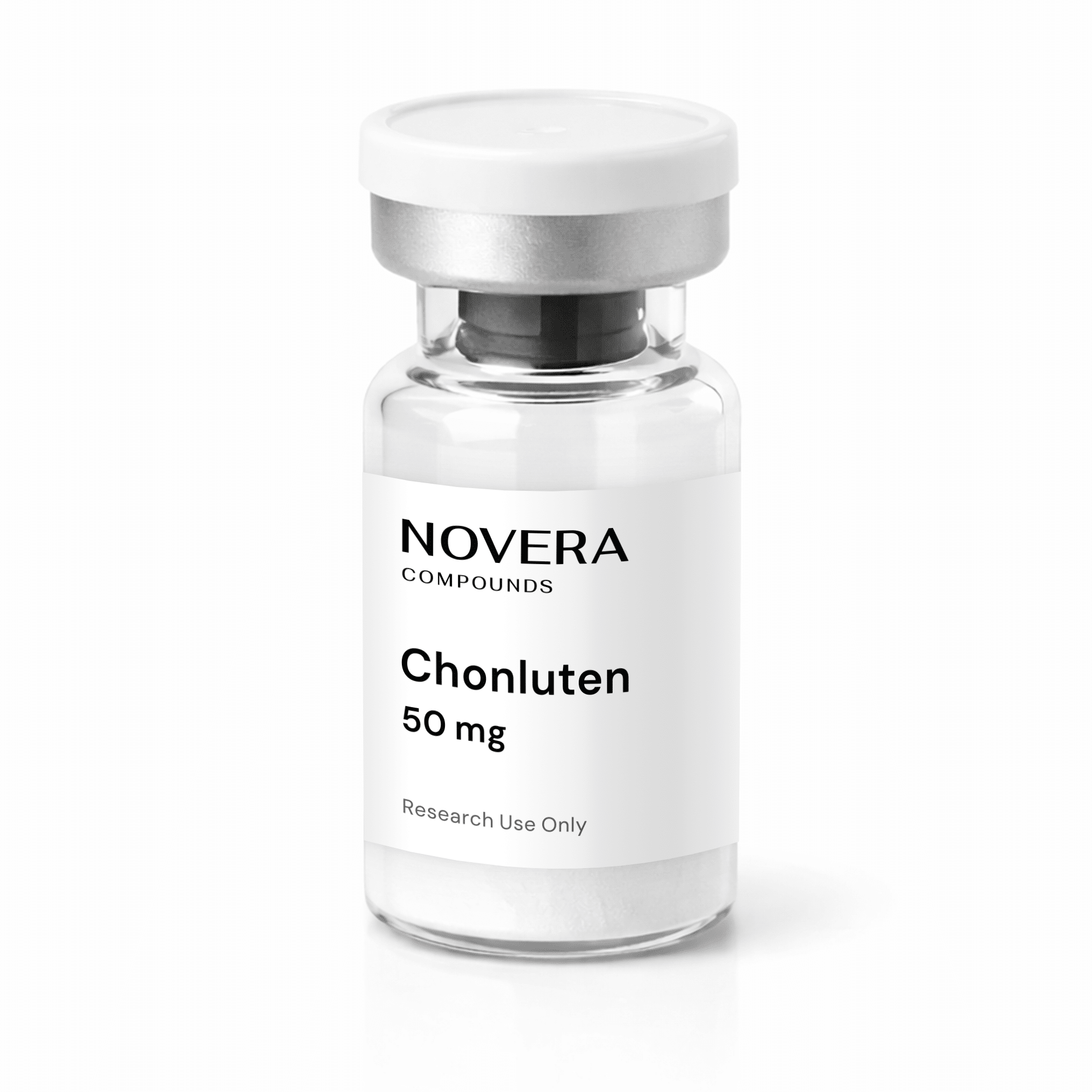
Chonluten 50mg
Coming Soon
This peptide will be available soon. Join the waitlist to be notified when it launches.
Product description
What is Chonluten (50mg)?
Chonluten (50mg) is a synthetic tripeptide bioregulator composed of three amino acids with the sequence Glu-Asp-Gly. It is classified under healing and regenerative peptides and is being studied for its potential role in regulating transcriptional activity and oxidative stress. Also known as:- Synonyms: EDG peptide, T-34, Glu-Asp-Gly tripeptide
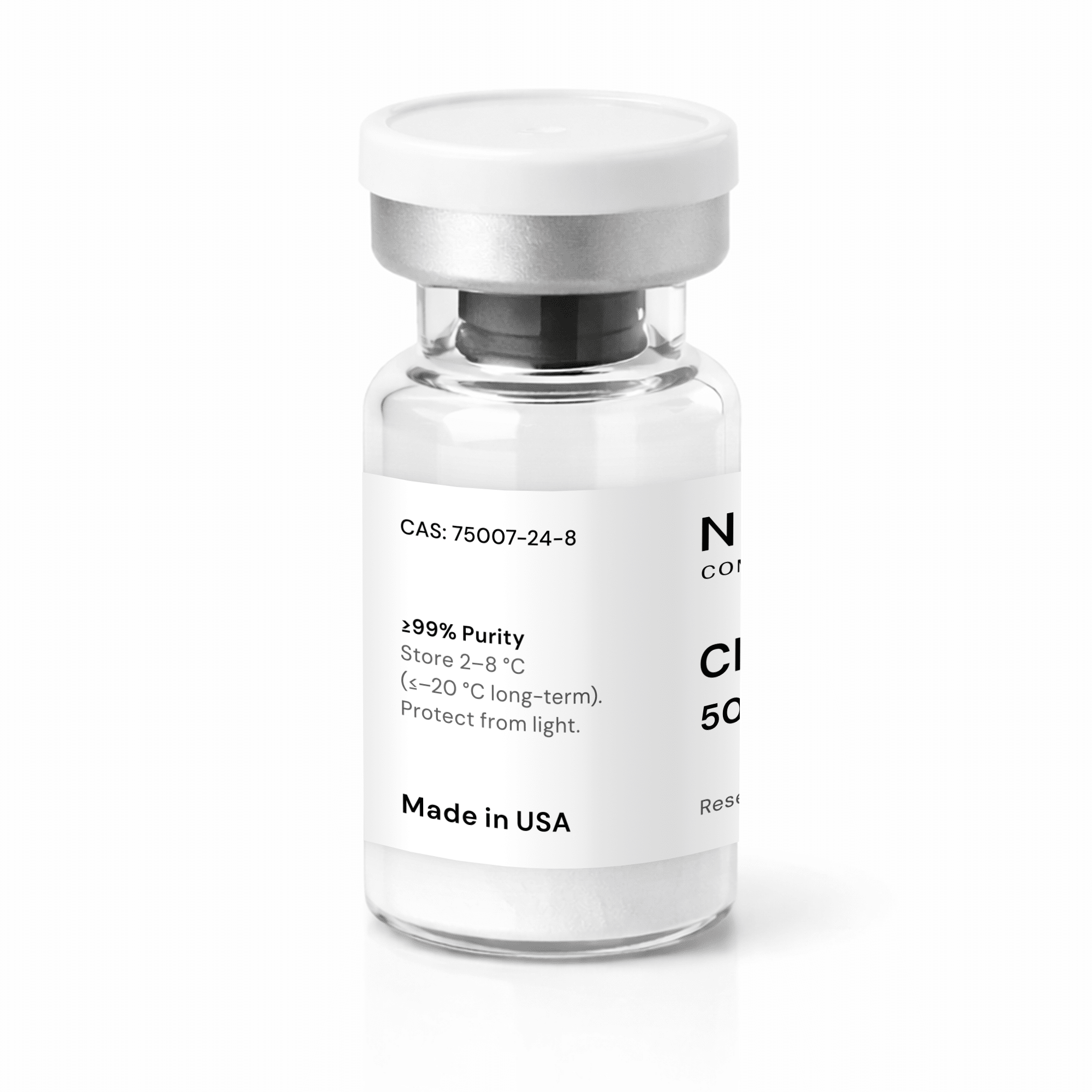
- CAS Number: 75007-24-8
- Chemical Formula: C₁₁H₁₇N₃O₈
- Molecular Weight: 319.27 g/mol
What are the key features of Chonluten (50mg)?
Chonluten (50mg) is supplied as a lyophilized peptide powder to ensure stability during storage and transport. This format supports precise laboratory reconstitution for controlled experimental conditions. Key features include:- Synthetic tripeptide (Glu-Asp-Gly) with a defined structure
- Purity ≥99%, confirmed by HPLC and MS
- 50 mg lyophilized vial for accurate reconstitution
- Investigated in respiratory and epithelial cell culture models
- Batch-specific Certificate of Analysis (COA) available
- Manufactured for controlled research applications
- Chonluten is commonly incorporated into experimental designs examining oxidative-stress pathways, inflammatory mediators, and gene-expression modulation
How is Chonluten (50mg) synthesized?
Chonluten (50mg) is synthesized using solid-phase peptide synthesis (SPPS), a method that allows precise assembly of the Glu-Asp-Gly tripeptide sequence. This process ensures high structural precision and batch-to-batch consistency. Unlike larger peptide bioregulators isolated from tissue fractions, Chonluten is a fully defined, linear tripeptide with no disulfide bonds or post-translational modifications, making it straightforward to synthesize at high purity and reproducibility. After synthesis, the crude peptide undergoes purification using reverse-phase HPLC to achieve high purity. Mass spectrometry (MS) confirms its molecular identity and molecular weight. Certificates of Analysis (COA) document analytical parameters such as retention time, purity percentage, and mass verification, ensuring batch consistency for laboratory use.What is Chonluten (50mg) being studied for? What are its possible benefits?
Chonluten is being studied for its potential to regulate gene-expression patterns associated with oxidative stress and inflammatory signaling. Research has focused on its effects in epithelial and respiratory tissue systems, where short regulatory peptides are evaluated for their roles in stress-response pathways. Areas under investigation include:- Modulation of oxidative-stress markers (e.g., superoxide dismutase activity)
- Evaluation of inflammatory mediators, such as TNF-α and COX-2
- Analysis of heat-shock proteins, including HSP70
- Examination of transcription factors, such as c-FOS
- Study of the epithelial barrier and regenerative processes
How does Chonluten (50mg) work in research studies?
In research studies, Chonluten functions as a short regulatory peptide that may influence cellular signaling and transcriptional activity. Its small size allows researchers to investigate its potential to interact with intracellular pathways involved in gene regulation and protein synthesis. Research suggests that peptides like Chonluten may:- Influence transcription-factor activity
- Affect oxidative-stress response genes
- Modulate inflammatory signaling cascades
- Contribute to cellular stress-adaptation mechanisms
What dosing information exists for Chonluten (50mg)?
Dosing information for Chonluten is based primarily on preclinical research. In respiratory and bronchial epithelial systems, peptide concentrations in the nanomolar range have been used to assess changes in oxidative-stress markers and inflammatory mediators such as TNF-α, COX-2, and HSP70. Some protocols have evaluated anti-inflammatory effects in murine airway models, though standardized in vivo dosing frameworks are not established. These dosing regimens are model-specific and designed for controlled experimental conditions. No approved or validated human dosing guidelines exist for Chonluten (50mg). All concentration data originate from controlled research environments.How should Chonluten (50mg) be stored and handled?
Chonluten (50mg) should be stored:- As a lyophilized powder at ≤–20 °C, protected from light and moisture, for long-term storage.
- A shelf life of up to 24 months is generally supported for research-grade peptides.
- Short-term room-temperature exposure during shipping is typically acceptable, given the stability of the dried format.
Where can I read more research about Chonluten (50mg)?
The following publications provide background on short peptide bioregulators and gene-expression research:- Avolio F, Martinotti S, Khavinson VK, et al. Peptides Regulating Proliferative Activity and Inflammatory Pathways in the Monocyte/Macrophage THP-1 Cell Line. Int J Mol Sci. 2022;23(7):3607. Published 2022 Mar 25. doi:10.3390/ijms23073607
- Khavinson VKh, Tendler SM, Vanyushin BF, et al. Peptide regulation of gene expression and protein synthesis in bronchial epithelium. Lung. 2014;192(5):781-791. doi:10.1007/s00408-014-9620-7
- Khavinson VKh, Lin'kova NS, Dudkov AV, Polyakova VO, Kvetnoi IM. Peptidergic regulation of expression of genes encoding antioxidant and anti-inflammatory proteins. Bull Exp Biol Med. 2012;152(5):615-618. doi:10.1007/s10517-012-1590-2
- Khavinson VK, Popovich IG, Linkova NS, Mironova ES, Ilina AR. Peptide Regulation of Gene Expression: A Systematic Review. Molecules. 2021;26(22):7053. Published 2021 Nov 22. doi:10.3390/molecules26227053
Compliance Statement
This product is intended for laboratory research use only and is not approved for human or veterinary use.Shop with Confidence: Product Authenticity is Guaranteed
All products available at Doctor Medica shop are obtained from respective manufacturers and contain original LOT numbers Contact us if you have any questions about product LOT numbers.