Your Cart is Empty
Start shopping

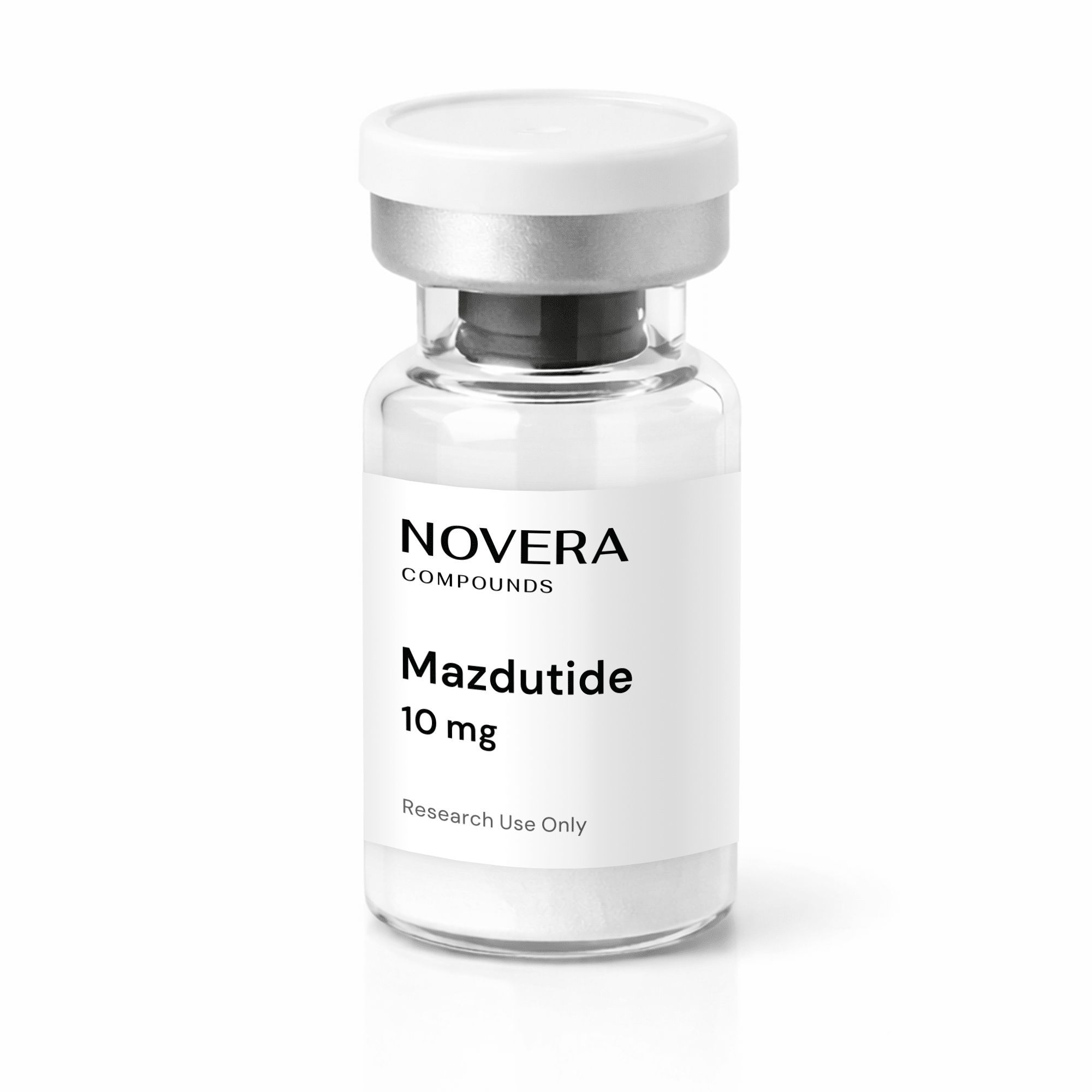
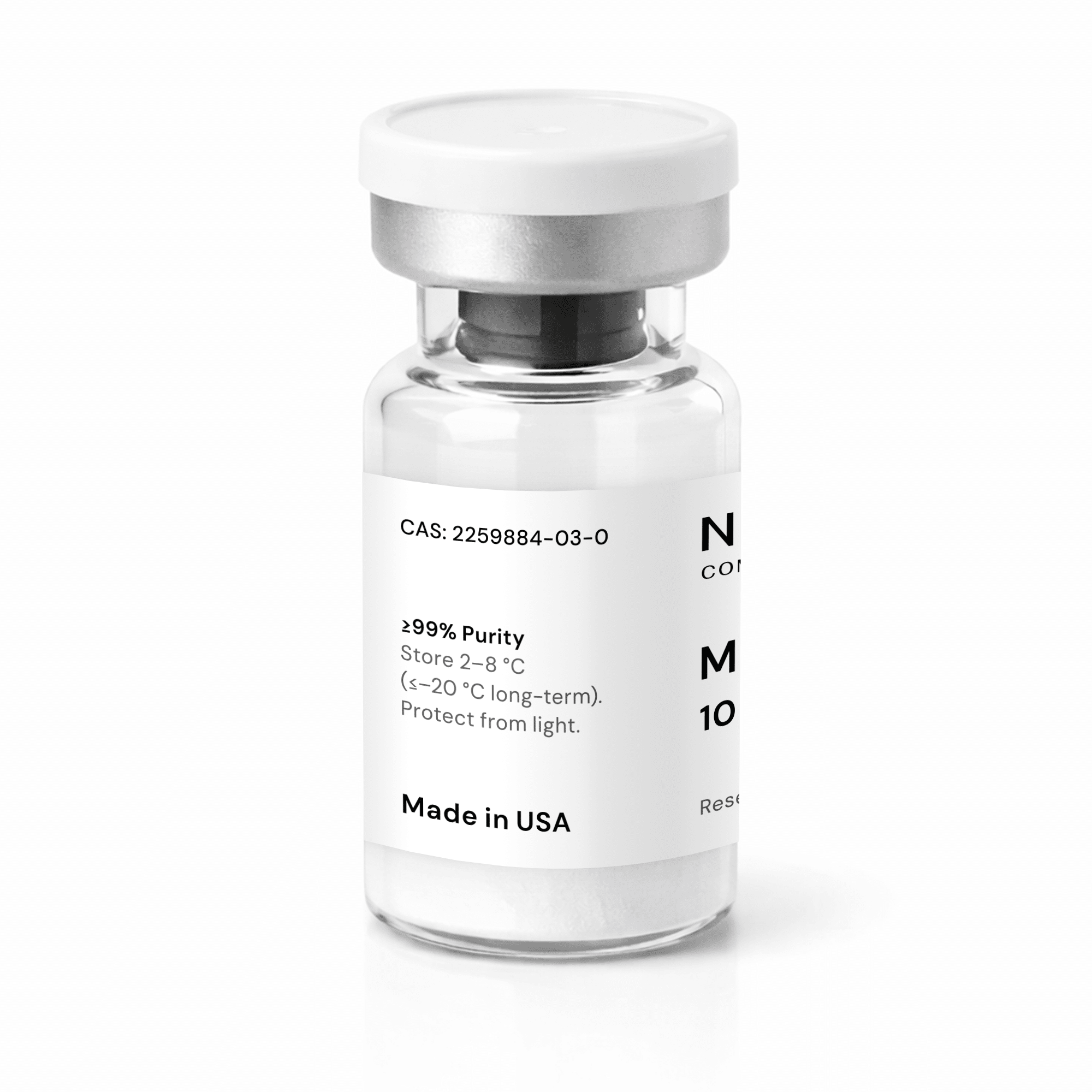
Mazdutide 10mg
Coming Soon
This peptide will be available soon. Join the waitlist to be notified when it launches.
Tier
| Packs | Discount (%) | For Each |
|---|---|---|
| 1 - 5 | — | $150.00 |
| 6 - 10 | 10 % | $135.00 |
| 11 - 20 | 18.67 % | $122.00 |
| 21+ | 26.67 % | $110.00 |
Shop with Confidence: 100% Authentic Products
All products are sourced from trusted suppliers and come with original manufacturer LOT numbers for identification and traceability.
Product description
What is Mazdutide (10mg)?
Mazdutide is a synthetic peptide analog studied in metabolic research for its dual incretin receptor agonist activity. It is designed to interact with biological pathways associated with incretin hormones, specifically targeting both GLP-1 and glucagon receptors. This peptide influences metabolic regulation, energy balance, and nutrient processing. Researchers focus on its potential interactions with these pathways in experimental models.
Mazdutide consists of approximately 33 amino acids and is typically produced with ≥98% purity, verified using high-performance liquid chromatography (HPLC) and mass spectrometry (MS). The peptide has been studied in preclinical and early clinical research examining metabolic pathways and peptide-based signaling systems. Anyone looking to order peptides for weight loss online should consider factors such as authenticity documentation, storage conditions, and sourcing practices when reviewing available information.
What are the key features of Mazdutide (10mg)?
Mazdutide (10mg) is supplied as a lyophilized peptide for controlled laboratory research. Due to its engineered structure, it is frequently included in metabolic and endocrine research studies investigating peptide signaling and energy balance mechanisms.
Key features of Mazdutide (10mg) include:
- Peptide class: Synthetic dual GLP-1 and glucagon receptor agonist
- CAS Number: 2259884-03-0
- Subcategory: Weight Loss & Metabolic Peptides
- Chemical Formula: C₂₁₀H₃₂₂N₄₆O₆₇
- Peptide Sequence: His-{Aib}-Gln-Gly-Thr-Phe-Thr-Ser-Asp-Tyr-Ser-Lys-Tyr-Leu-Asp-Glu-Lys-Lys-Ala-Lys-{AEEA-AEEA-γGlu-Eicosanedioic acid}-Glu-Phe-Val-Glu-Trp-Leu-Leu-Glu-Gly-Gly-Pro-Ser-Ser-Gly-NH2
- Molecular weight: 4563.06 g/mol
- Purity: Typically ≥98%, verified through HPLC analysis
- Analytical confirmation: Mass spectrometry (MS) testing
- Format: Sterile lyophilized powder supplied in a research vial
For laboratory research use only.
How is Mazdutide (10mg) synthesized?
Mazdutide is produced using solid-phase peptide synthesis (SPPS), a widely used laboratory technique for constructing peptides with defined amino acid sequences. In this process, amino acids are sequentially attached to a solid resin support to form the peptide backbone. Protective chemical groups ensure correct binding, preventing unwanted reactions.
After synthesis, the peptide undergoes purification using high-performance liquid chromatography (HPLC) to remove incomplete peptide fragments and impurities. Structural confirmation is then performed using mass spectrometry (MS) to verify the peptide’s molecular weight and identity. The final compound is lyophilized to minimize degradation and facilitate laboratory handling.
What is Mazdutide (10mg) being studied for? What are its possible benefits?
Mazdutide has been studied in research focused on metabolic regulation and endocrine signaling. Designed as a dual agonist at GLP-1 and glucagon receptors, it has been investigated for its potential interactions with biological processes that regulate energy balance, glucose metabolism, and lipid metabolism in experimental systems.
Research has also examined Mazdutide in clinical and preclinical studies focusing on body weight regulation, metabolic signaling, and hormonal pathways involved in appetite and energy expenditure. These areas remain under investigation, and available data mainly come from controlled research environments. Current studies aim to better understand how engineered peptides like Mazdutide interact with metabolic pathways at both the cellular and systemic levels.
How does Mazdutide (10mg) work in research studies?
In laboratory studies, Mazdutide is evaluated for its potential modulation of metabolic signaling pathways associated with incretin hormones. These hormones coordinate communication between the digestive system and metabolic tissues. Researchers study how the peptide may affect cellular signals related to nutrient sensing and metabolic balance.
Experimental models have examined how Mazdutide may influence biological pathways associated with hormone-regulated metabolism, including processes linked to energy utilization and glucose regulation. In research settings, the peptide is assessed in cell systems and animal models to observe changes in metabolic markers and signaling pathways. The precise mechanisms remain an active area of investigation.
What dosing information exists for Mazdutide (10mg)?
Dosing information for Mazdutide is mainly derived from preclinical research and clinical trials evaluating peptide-based metabolic regulators. In experimental animal models, incretin-related peptides have been studied at a range of microgram to milligram per kilogram dosing levels, depending on study design and duration.
In laboratory and preclinical research, peptides of this class are sometimes studied at concentrations designed to evaluate metabolic responses or signaling effects. Dosing approaches vary significantly between research protocols. There are no established dosing guidelines for human use in laboratory product contexts, and Mazdutide supplied for research is intended solely for experimental study.
How should Mazdutide (10mg) be stored and handled?
If you order Mazdutide online, following appropriate cold chain and reconstitution guidelines is essential for proper product handling and evaluation. Lyophilized Mazdutide should typically be stored at –20 °C in a controlled laboratory environment to minimize degradation and protect peptide structural integrity. The compound should be protected from light, moisture, and excessive heat.
After reconstitution with an appropriate sterile laboratory solvent, the peptide solution is generally stored at 2–8 °C for short-term laboratory use. Researchers should avoid repeated freeze-thaw cycles, as they can compromise peptide stability. Peptide integrity may vary depending on storage conditions, solvent compatibility, and laboratory handling procedures.
Citations
Researchers interested in Mazdutide and related incretin-based peptide research can explore several scientific databases and journals that publish studies on metabolic peptides and endocrine signaling pathways. Examples of commonly cited research sources include:
- Ji L, Jiang H, Cheng Z, et al. A phase 2 randomised controlled trial of mazdutide in Chinese overweight adults or adults with obesity. Nat Commun. 2023;14(1):8289. Published 2023 Dec 14. doi:10.1038/s41467-023-44067-4
- Ji L, Jiang H, An P, et al. IBI362 (LY3305677), a weekly-dose GLP-1 and glucagon receptor dual agonist, in Chinese adults with overweight or obesity: A randomised, placebo-controlled, multiple ascending dose phase 1b study. EClinicalMedicine. 2021;39:101088. Published 2021 Aug 13. doi:10.1016/j.eclinm.2021.101088
- Drucker DJ, Habener JF, Holst JJ. Discovery, characterization, and clinical development of the glucagon-like peptides. J Clin Invest. 2017;127(12):4217-4227. doi:10.1172/JCI97233
- National Center for Biotechnology Information. PubChem Compound Summary for CID 167312357, Mazdutide. https://pubchem.ncbi.nlm.nih.gov/compound/Mazdutide
Compliance Statement
This product is intended for laboratory research use only and is not approved for human or veterinary use.
All claims and references on this page apply only to the genuine product, and not replicas or products that cannot be traced back to the official manufacturer. Read more to learn how product authenticity is verified.