Your Cart is Empty
Start shopping

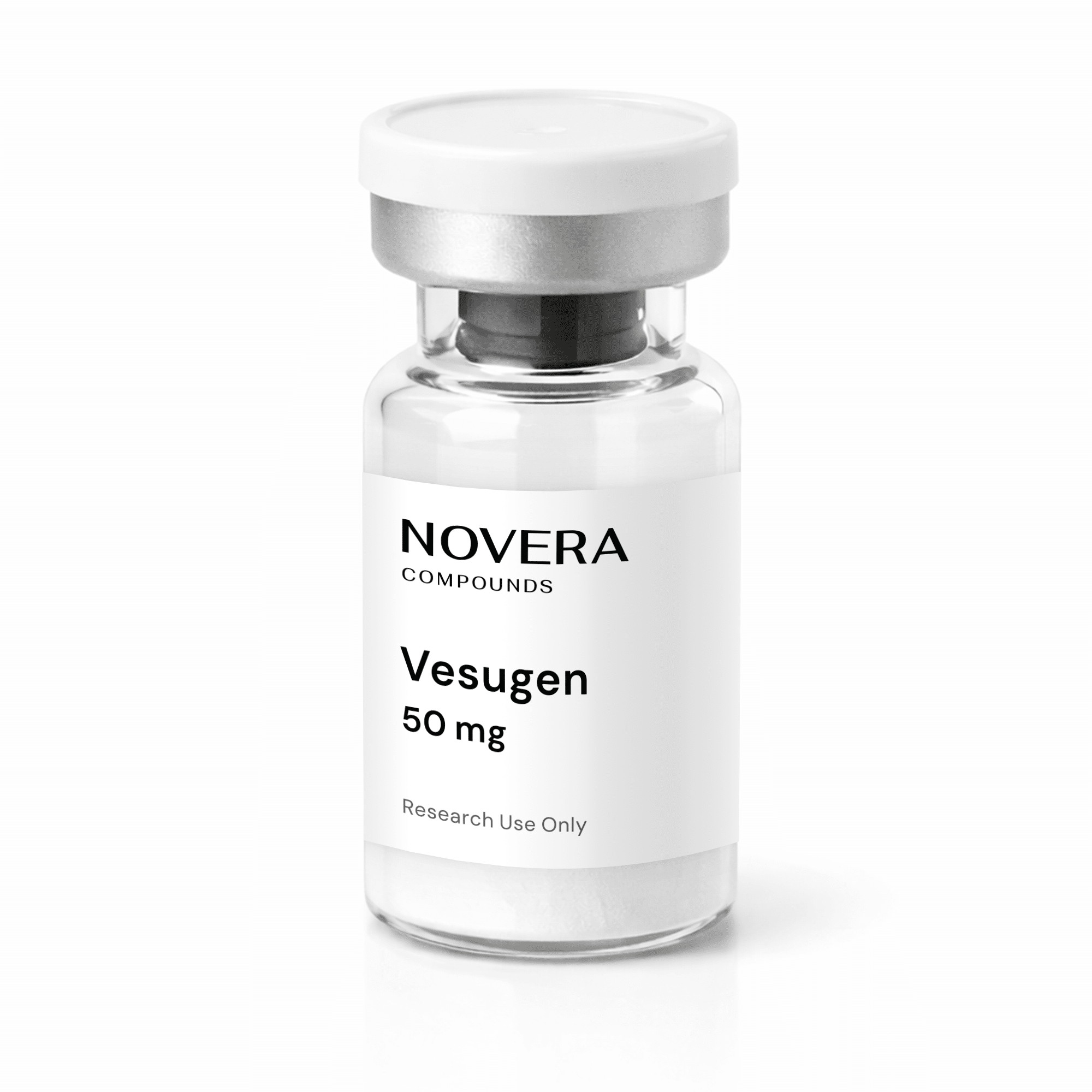
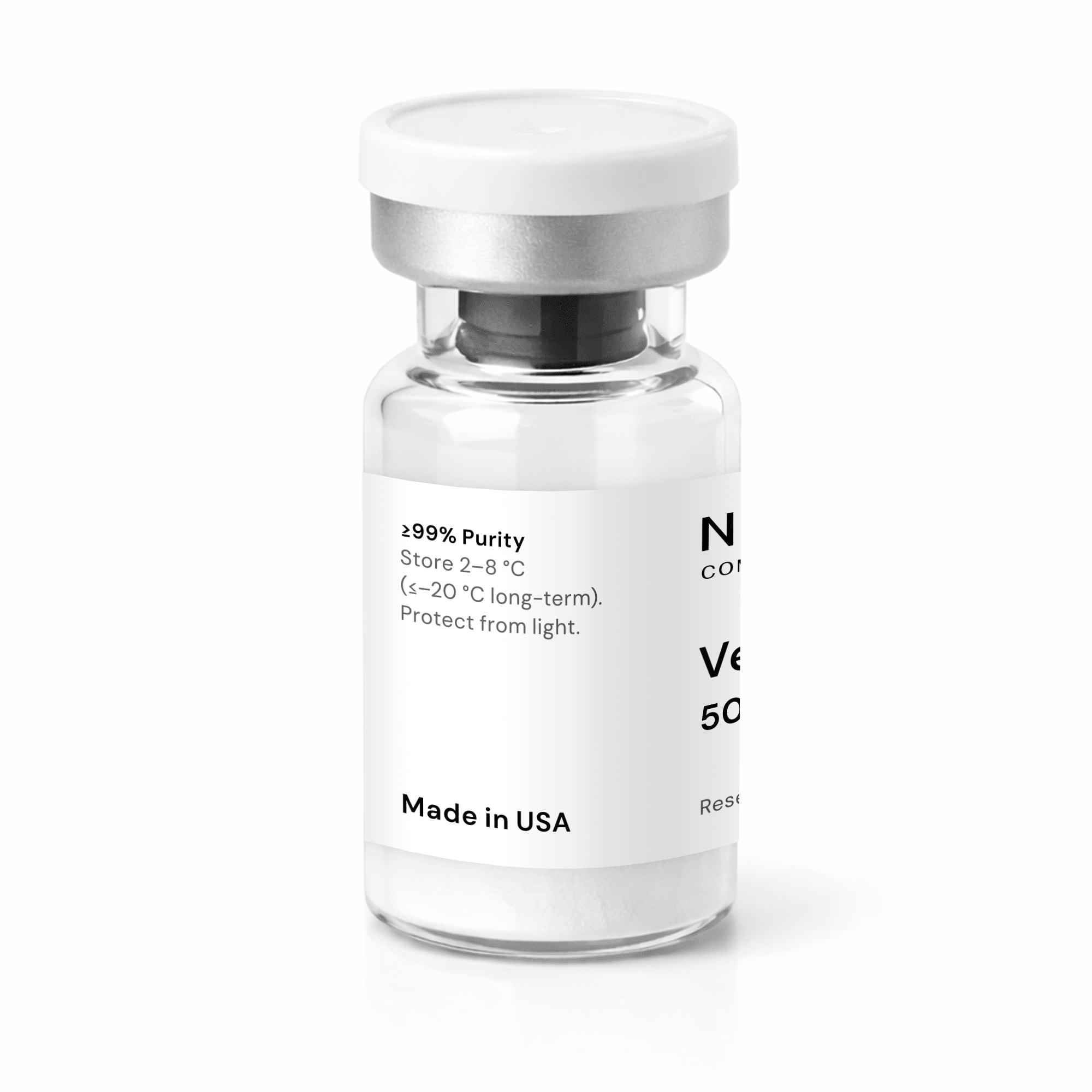
Vesugen 50mg
Coming Soon
This peptide will be available soon. Join the waitlist to be notified when it launches.
Product description
What is Vesugen (50mg)?
Vesugen (50mg) is a synthetic tripeptide belonging to the group of organ-specific and bioregulator peptides. The peptide is composed of three amino acids—lysine, glutamic acid, and aspartic acid—and has been studied in laboratory models examining vascular biology and cellular gene regulation. Because of its compact structure, Vesugen is often investigated for its potential to influence molecular signaling within endothelial and neural tissues. Also referenced as the T-38 peptide, this tripeptide has the following characteristics:- Peptide Sequence: Lys-Glu-Asp (KED)
- Molecular Weight: 390.39 g/mol
- Chemical Formula: C₁₅H₂₆N₄O₈
What are the key features of Vesugen (50mg)?
- Short tripeptide structure composed of lysine, glutamic acid, and aspartic acid
- High analytical purity (typically ≥99%) confirmed through HPLC and mass spectrometry
- Supplied as a 50 mg lyophilized research vial for laboratory experimentation
- Studied in models of vascular biology and endothelial cell regulation
- Investigated for its role in cellular aging and gene expression pathways
- Compact molecular structure that may support cellular and nuclear interaction studies
- For laboratory research use only
How is Vesugen (50mg) synthesized?
Vesugen is produced via synthetic peptide synthesis, typically solid-phase peptide synthesis (SPPS). This method allows scientists to assemble the peptide sequence step by step by attaching individual amino acids to a solid support resin. For Vesugen, the sequence Lys-Glu-Asp is formed through sequential coupling reactions under controlled laboratory conditions. After synthesis, the peptide is purified by high-performance liquid chromatography (HPLC) to remove incomplete sequences or residual reagents. The final compound is then verified using mass spectrometry (MS) to confirm its molecular weight and sequence accuracy. Once quality testing is completed, the peptide is lyophilized and sealed in research vials to support long-term stability during storage and transport.What is Vesugen (50mg) being studied for? What are its possible benefits?
Vesugen has been investigated in laboratory studies focusing on vascular cell biology and gene expression. Research suggests the peptide may influence molecular pathways associated with endothelial cell growth, oxidative stress responses, and vascular tissue maintenance. Studies involving endothelial cultures have explored its effects on markers related to cell proliferation and intercellular communication. Additional research has examined Vesugen in experimental models studying aging-related vascular changes, microcirculation, and metabolic stress. Investigators have also explored its possible role in neurovascular interactions, where vascular and neural tissues communicate to support brain function. These research areas remain exploratory and are primarily examined within controlled laboratory environments.How does Vesugen (50mg) work in research studies?
In laboratory experiments, Vesugen is thought to influence gene expression and cellular signaling within vascular tissues. Some studies suggest the peptide may interact with DNA regulatory regions or transcription mechanisms that control genes associated with endothelial growth and vascular integrity. This activity has made Vesugen a subject of interest in research examining epigenetic regulation. In neuronal and vascular models, Vesugen has also been associated with changes in cellular signaling pathways that may support communication between endothelial and neural cells. These processes are believed to involve regulation of proteins linked to cellular metabolism and stress responses. However, these mechanisms remain under investigation and are being studied in controlled experimental systems.What dosing information exists for Vesugen (50mg)?
Published experimental literature reports a range of concentrations depending on the research model being used. In cell culture studies, Vesugen has been applied at micromolar concentrations to evaluate its influence on endothelial gene expression and cellular activity over several hours to days. In preclinical animal studies, researchers have used low-dose peptide administration in the microgram-per-kilogram range when exploring vascular or metabolic responses. These experimental protocols vary widely depending on the study objective and biological model. It is important to note that no standardized human dosing guidelines exist, and all dosing parameters are determined by the specific research design.How should Vesugen (50mg) be stored and handled?
- Store the lyophilized peptide at ≤–20 °C for long-term preservation
- Keep containers protected from light, moisture, and contamination
- After reconstitution, keep the solution at 2–8 °C for short-term storage
- Prepare aliquots to avoid repeated freeze–thaw cycles
- Room temperature exposure during shipping is acceptable if brief and sealed
- When stored correctly, the peptide may remain stable for up to 24 months
Where can I read more research about Vesugen (50mg)?
- Khavinson VK, Lin'kova NS, Tarnovskaya SI. Short Peptides Regulate Gene Expression. Bull Exp Biol Med. 2016;162(2):288-292. doi:10.1007/s10517-016-3596-7
- Khavinson VK, Popovich IG, Linkova NS, Mironova ES, Ilina AR. Peptide Regulation of Gene Expression: A Systematic Review. Molecules. 2021;26(22):7053. Published 2021 Nov 22. doi:10.3390/molecules26227053
- Khavinson V, Ilina A, Kraskovskaya N, et al. Neuroprotective Effects of Tripeptides-Epigenetic Regulators in Mouse Model of Alzheimer's Disease. Pharmaceuticals (Basel). 2021;14(6):515. Published 2021 May 27. doi:10.3390/ph14060515
Compliance Statement
This product is intended for laboratory research use only and is not approved for human or veterinary use.Shop with Confidence: Product Authenticity is Guaranteed
All products available at Doctor Medica shop are obtained from respective manufacturers and contain original LOT numbers Contact us if you have any questions about product LOT numbers.