Your Cart is Empty
Start shopping

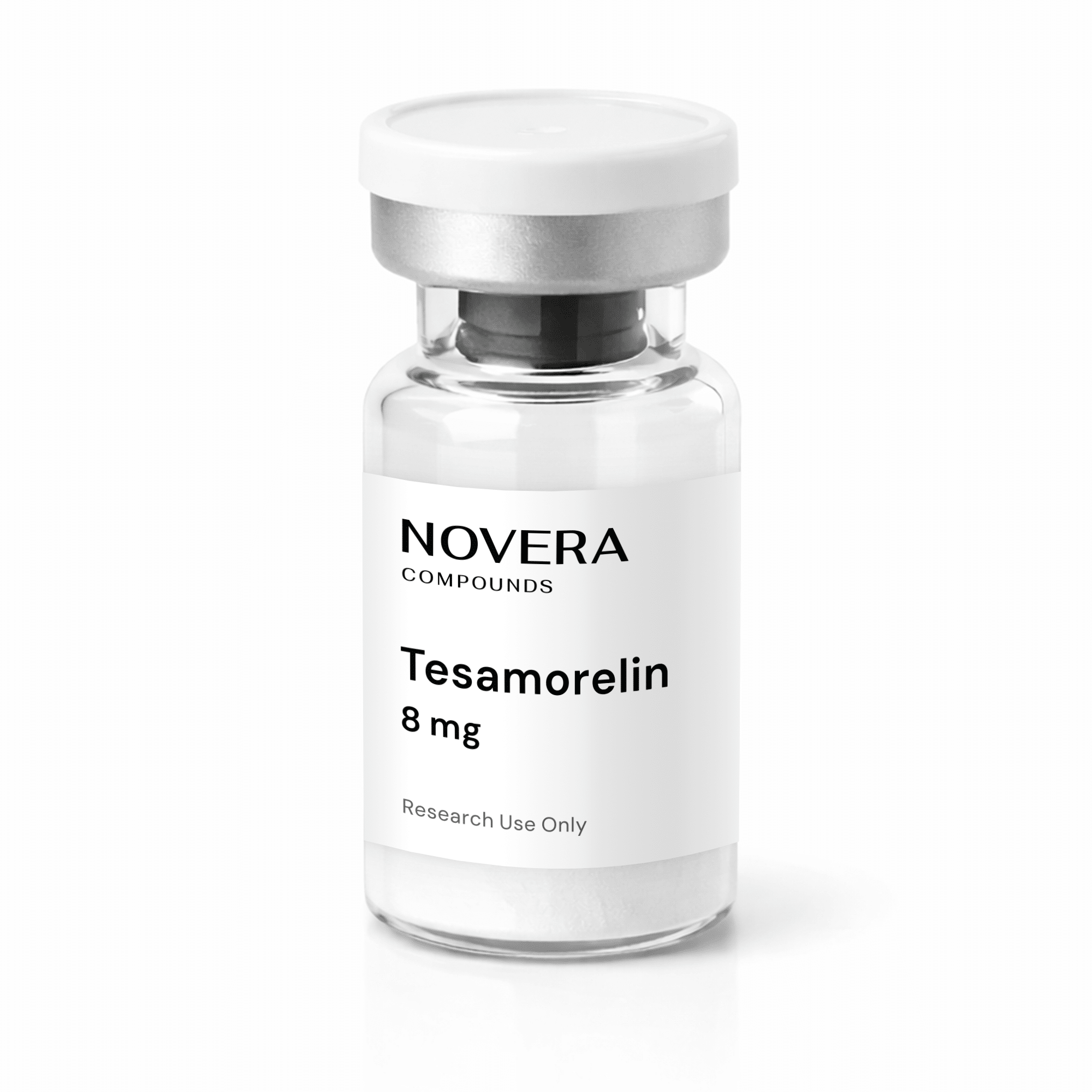
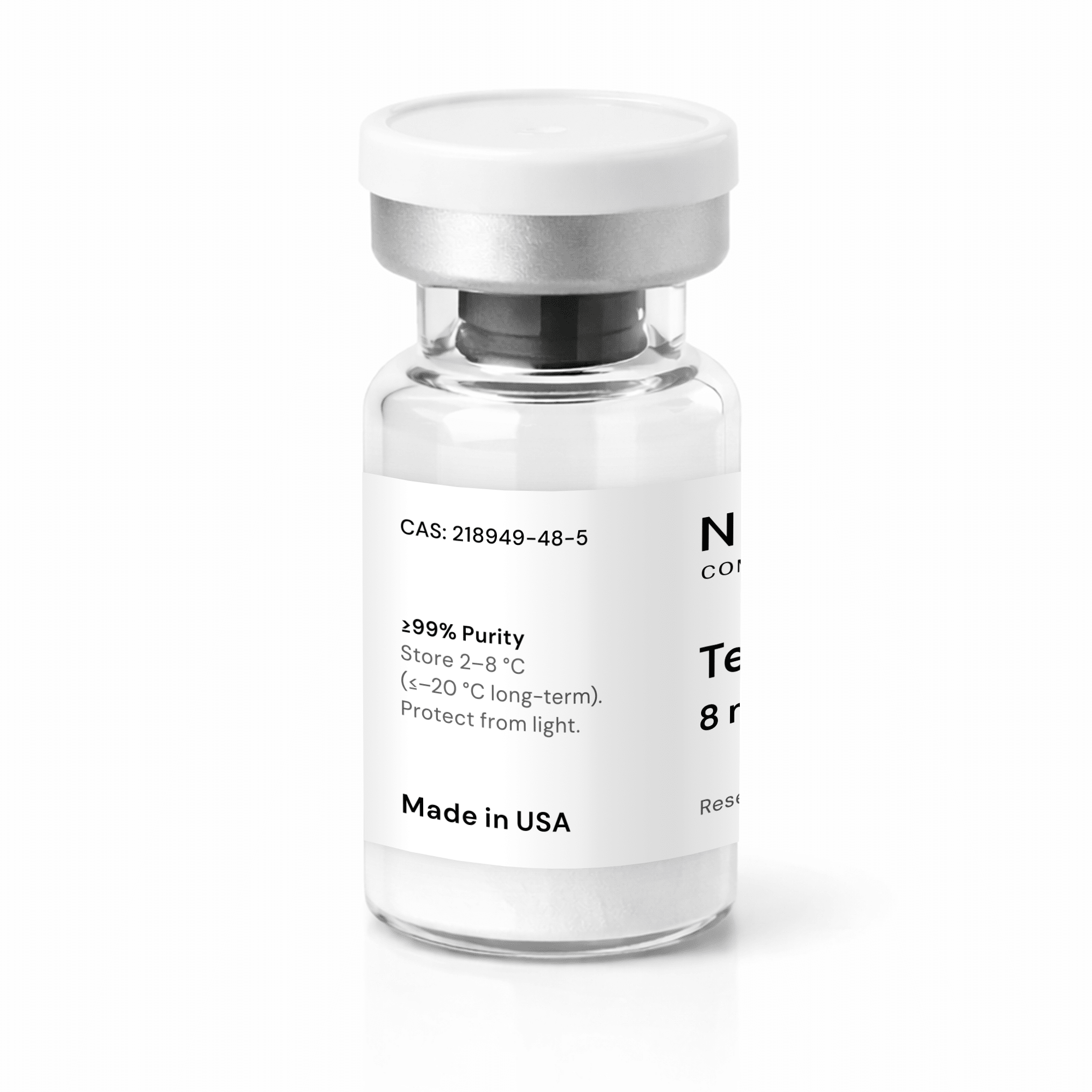
Tesamorelin 8mg
Coming Soon
This peptide will be available soon. Join the waitlist to be notified when it launches.
Tier
| Packs | Discount (%) | For Each |
|---|---|---|
| 1 - 5 | — | $86.00 |
| 6 - 10 | 1.16 % | $85.00 |
| 11 - 20 | 2.33 % | $84.00 |
| 21+ | 3.49 % | $83.00 |
Shop with Confidence: 100% Authentic Products
All products are sourced from trusted suppliers and come with original manufacturer LOT numbers for identification and traceability.
Product description
What is Tesamorelin (8mg)?
Tesamorelin (8mg) is a synthetic peptide that functions as a stabilized analog of growth hormone–releasing hormone (GHRH). It is designed to mimic the biological activity of endogenous GHRH while improving stability in experimental systems. The peptide contains 44 amino acids and is typically supplied as a lyophilized powder for laboratory research.
In preclinical and experimental research, Tesamorelin has been studied for its role in regulating the somatotropic axis, particularly through its influence on growth hormone (GH) and IGF-1 signaling. When you buy Tesamorelin online, reviewing available sourcing details and storage requirements can help provide a clearer understanding of product handling practices.
Key chemical identifiers include:
- CAS Number: 218949-48-5
- Chemical Formula: C₂₂₁H₃₆₆N₇₂O₆₇S
- Molecular Weight: 5136 g/mol
- Peptide Sequence: Trans-3-hexenoyl-YADAIFTNSYRKVLGQLSARKLLQDIMSRQQGESNQERGARARL-NH₂
Also referenced as TH9507, Tesamorelin is commonly produced with high purity and often verified by analytical techniques such as HPLC and mass spectrometry to ensure reliable results in experimental settings.
What are the key features of Tesamorelin (8mg)?
- Synthetic 44-amino acid peptide derived from the structure of GHRH
- Supplied as an 8 mg lyophilized peptide vial for research preparation
- High purity, commonly ≥98–99%, verified through HPLC testing
- Identity confirmed through mass spectrometry (MS) and analytical characterization
- Studied in relation to GH/IGF-1 signaling, metabolism, and endocrine regulation
- Suitable for in-vitro, cell culture, and preclinical research models
- For laboratory research use only
How is Tesamorelin (8mg) synthesized?
Tesamorelin is produced by solid-phase peptide synthesis (SPPS), which assembles the peptide chain one amino acid at a time on a resin. After the complete sequence is assembled, the peptide is cleaved, side-chain protecting groups are removed, and the crude product is purified.
Purification typically uses preparative HPLC to remove truncated sequences and chemical byproducts. Final characterization includes analytical HPLC for purity assessment and high-resolution mass spectrometry to confirm molecular weight and sequence integrity.
These quality checks ensure lot-to-lot consistency necessary for receptor pharmacology and signaling assays.
What is Tesamorelin (8mg) being studied for? What are its possible benefits?
Tesamorelin has been studied in preclinical and experimental research examining the relationship between growth hormone signaling, metabolism, and body composition. Several investigations have focused on how GHRH analogs may influence visceral adipose tissue, metabolic markers, and circulating IGF-1 levels in preclinical and experimental models. Clinicians who buy peptides for muscle growth online can access a promising peptide compound that has gained interest for its potential role in supporting research related to muscle preservation, body composition, and metabolic health.
Additional research explores how Tesamorelin may affect pathways related to lipid metabolism, cellular signaling, and tissue remodeling. Some studies have reported associations between Tesamorelin exposure and changes in skeletal muscle density, metabolic biomarkers, and endocrine feedback loops. These potential biological outcomes remain under investigation and should be interpreted as experimental observations rather than confirmed biological outcomes.
How does Tesamorelin (8mg) work in research studies?
In experimental studies, Tesamorelin is believed to influence the pituitary signaling pathway responsible for regulating growth hormone production. When the peptide interacts with endocrine signaling systems, it may stimulate growth hormone release, which can subsequently increase circulating IGF-1 levels. Researchers use this mechanism to study how hormonal signals influence metabolism and tissue physiology.
The peptide’s modified structure helps maintain stability in laboratory models, allowing researchers to observe more consistent patterns of growth hormone release compared with shorter peptide fragments. These characteristics make Tesamorelin useful in experiments exploring endocrine feedback mechanisms, metabolic regulation, and cellular responses associated with anabolic signaling pathways.
What dosing information exists for Tesamorelin (8mg)?
Preclinical dosing in rodent models typically involves subcutaneous administration in the microgram-per-kilogram range, with dose selection depending on species, sampling interval, and study objective. Dose design should be guided by peer-reviewed preclinical protocols. No standardized human dosing guidelines exist for Tesamorelin (8mg) as a research reagent.
How should Tesamorelin (8mg) be stored and handled?
- Store the lyophilized peptide at ≤–20 °C for long-term storage
- Protect from light and moisture to maintain peptide stability
- After reconstitution, store solutions at 2–8 °C for short-term use
- Avoid repeated freeze–thaw cycles by preparing aliquots
- Limited room-temperature exposure during transport is generally acceptable
- Unopened lyophilized vials may remain stable for up to 24 months when properly stored
Citations
[4] Recinella L, Chiavaroli A, Orlando G, Ferrante C, Marconi GD, Gesmundo I, Granata R, Cai R, Sha W, Schally AV, Brunetti L, Leone S. Antinflammatory, antioxidant, and behavioral effects induced by administration of growth hormone-releasing hormone analogs in mice. Sci Rep. 2020 Jan 20;10(1):732. doi: 10.1038/s41598-019-57292-z. Erratum in: Sci Rep. 2020 Mar 11;10(1):4850. doi: 10.1038/s41598-020-61185-x. PMID: 31959947; PMCID: PMC6971229.
[5] Müller EE, Locatelli V, Cocchi D. Neuroendocrine control of growth hormone secretion. Physiol Rev. 1999 Apr;79(2):511-607. doi: 10.1152/physrev.1999.79.2.511. PMID: 10221989.
Compliance Statement
This product is intended for laboratory research use only and is not approved for human or veterinary use.
Doctor Medica sources products exclusively through authorized distributors and established procurement channels. Products are verified as genuine, and supplied in the original packaging with their seal intact. Learn more about how we guarantee product authenticity, sourcing compliance, and traceable delivery to our clients.